
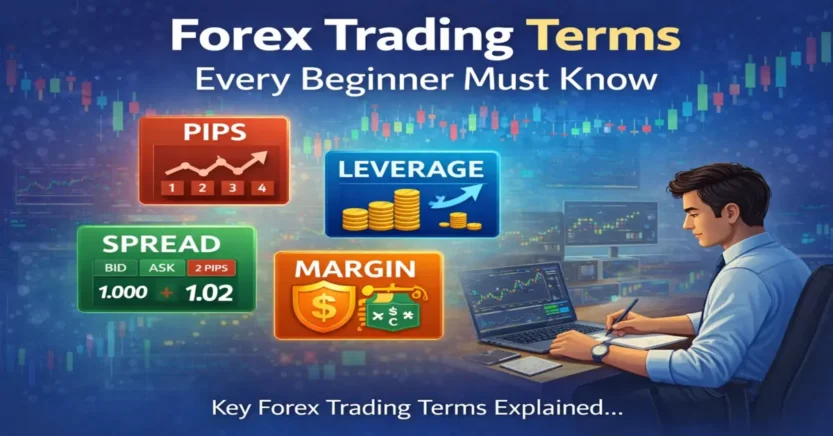
Why Learning Forex Terms Is Important
Forex trading can seem confusing at first. However, many beginners struggle not because trading is difficult, but because they do not understand the basic terms. Therefore, learning forex trading terms every beginner must know is the first step toward becoming a successful trader.
In this guide, you will discover the most important forex terms explained in simple language. In addition, you will learn how these terms apply in real trading situations. As a result, you will gain confidence and make better trading decisions.
Before you start trading, you must understand the language of the forex market. Otherwise, you may misinterpret signals, misunderstand strategies, or make costly mistakes.
For example, if you do not understand what “leverage” means, you might risk more than you can afford. Similarly, without knowing what a “pip” is, you cannot measure profit or loss accurately.
Therefore, understanding these terms will help you:
-
Communicate effectively with other traders
-
Understand trading platforms
-
Apply strategies correctly
-
Manage risk more efficiently
If you are just starting out, you should first understand the basics through this detailed guide on
What Is Forex Trading? A Beginner’s Complete Guide, as it will help you build a strong foundation.
Basic Forex Trading Terms
Let’s start with the most fundamental terms that every beginner must know.
1. Currency Pair
A currency pair is the quotation of two currencies. In forex trading, you always trade one currency against another.
For example:
-
EUR/USD (Euro vs US Dollar)
-
GBP/USD (British Pound vs US Dollar)
The first currency is called the base currency, while the second is the quote currency.
2. Pip
A pip is the smallest price movement in a currency pair. In most cases, it is used to measure changes in value.
For most currency pairs:
-
1 pip = 0.0001
Therefore, understanding pips is essential for tracking your performance.
3. Lot Size
A lot size refers to the number of units you are trading. Generally, different lot sizes help traders manage risk.
-
Standard lot = 100,000 units
-
Mini lot = 10,000 units
-
Micro lot = 1,000 units
As a beginner, it is safer to start small. This way, you reduce your exposure to risk.
4. Spread
The spread is the difference between the buy price (ask) and the sell price (bid).
For example:
-
Buy: 1.1002
-
Sell: 1.1000
The spread = 2 pips
In simple terms, this is how brokers earn money. Therefore, lower spreads are better for traders.
5. Leverage
Leverage allows you to control a large position with a small amount of money. For instance, with 1:100 leverage, you can control $10,000 with just $100.
However, leverage increases both profit and risk. Therefore, it must be used carefully.
6. Margin
Margin is the amount of money required to open a trade. In other words, it is a deposit held by your broker.
7. Balance vs Equity
Understanding balance and equity is very important.
-
Balance = account without open trades
-
Equity = account including open trades
As a result, equity changes constantly based on market movement.
Intermediate Forex Trading Terms
Now that you understand the basics, let’s move to more advanced terms.
8. Stop-Loss
A stop-loss automatically closes your trade to limit losses. Therefore, it is a key risk management tool.
9. Take Profit
Take profit closes your trade when your target is reached. As a result, you secure profits without monitoring the market constantly.
10. Slippage
Slippage occurs when your trade executes at a different price. This usually happens during high volatility.
11. Liquidity
Liquidity refers to how easily a currency can be traded. Generally, higher liquidity means faster execution and lower costs.
12. Volatility
Volatility measures how much the market moves.
-
High volatility = large movements
-
Low volatility = small movements
For example, gold (XAUUSD) is highly volatile.
Advanced Forex Terms
As you progress, you will encounter more technical concepts.
13. Bullish Market
A bullish market means prices are rising. Therefore, traders look for buying opportunities.
14. Bearish Market
A bearish market means prices are falling. In contrast, traders focus on selling opportunities.
15. Support and Resistance
Support is where price stops falling, while resistance is where price stops rising.
These levels help traders identify entries and exits. Therefore, they are essential tools.
16. Trend
A trend shows the overall direction of the market.
-
Uptrend = higher highs
-
Downtrend = lower lows
As a result, trading with the trend improves accuracy.
17. Breakout
A breakout occurs when price moves beyond key levels. Consequently, it often signals strong momentum.
Platform-Related Terms
18. MetaTrader (MT4/MT5)
These platforms allow you to analyze charts and place trades. Therefore, they are widely used by traders.
To apply these concepts in real-time, you can analyze the market using advanced charting tools and indicators such as tradingview
19. Trading Account Types
Different brokers offer various account types.
-
Demo account
-
Standard account
-
ECN account
As a beginner, you should start with a demo account. This helps you practice safely.
20. Swap
A swap is the interest paid or earned overnight. Therefore, it affects long-term trades.
Common Mistakes Beginners Make
Even with knowledge, beginners still make mistakes.
1. Ignoring Basics
As a result, they misunderstand trading.
2. Misusing Leverage
Consequently, losses increase quickly.
3. Not Using Stop-Loss
Therefore, risk becomes uncontrolled.
4. Overtrading
As a result, emotions take over.
5. Lack of Practice
Therefore, progress becomes slow.
Tips to Master Forex Terms Faster
To improve quickly:
-
Practice daily
-
Read regularly
-
Watch tutorials
-
Keep notes
-
Apply knowledge
As a result, your understanding will improve faster.
How Forex Terms Improve Your Trading
Understanding terms directly improves performance.
For example:
-
Pip → measures profit
-
Leverage → controls risk
-
Trend → identifies direction
Therefore, knowledge leads to better decisions.
Final Thoughts
In conclusion, learning forex trading terms every beginner must know is essential for success. Without this knowledge, trading becomes risky and confusing.
However, once you understand these terms, everything becomes clearer. As a result, you can trade with confidence and improve over time.
