
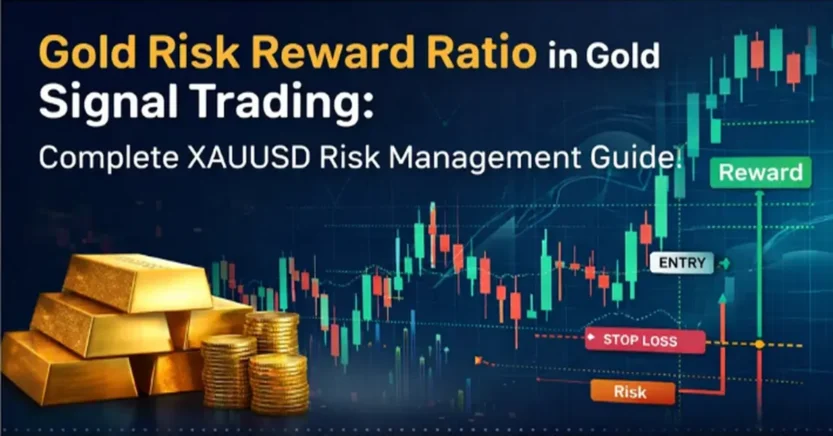
Gold Risk Reward Ratio in Gold Signal Trading: Complete XAUUSD Risk Management Guide
Gold risk reward ratio is one of the most important concepts in gold signal trading. It helps traders manage risk, protect capital, and improve profitability in XAUUSD trading. However, many traders focus only on entry signals and ignore proper risk management. As a result, they often lose money even when their market analysis is correct.
Therefore, the risk-to-reward ratio in gold signal trading helps traders manage risk and protect their capital while maximizing potential profit. Instead of chasing every trade, traders focus on structured entries with controlled losses and realistic profit targets. Consequently, trading becomes more disciplined and sustainable.
In this guide, you will learn how risk-to-reward ratio works in gold trading, how to apply it to XAUUSD signals, and how to improve long-term profitability.
Understanding Risk-to-Reward Ratio in Gold Trading
Risk-to-reward ratio measures the potential profit compared to the possible loss in a trade. In simple terms, it shows how much a trader is willing to risk to make a certain amount of profit.
For example, if a trader risks $10 to make $30, the risk-to-reward ratio becomes 1:3. This means the potential reward is three times higher than the risk.
This concept is essential in gold trading because XAUUSD moves quickly and unpredictably. Therefore, traders must protect their capital by ensuring that every trade offers a favorable reward compared to risk.
In addition, using proper risk-to-reward ratios helps traders stay profitable even if some trades fail.
Why Risk Management Matters in Gold Signal Trading
Gold trading signals provide entry and exit points. However, signals alone cannot guarantee profit without proper risk control.
For this reason, risk-to-reward ratio improves trading performance in several ways:
- It protects trading capital
- It reduces emotional trading
- It improves long-term profitability
- It encourages disciplined strategy
- It helps traders manage losses effectively
Moreover, traders who follow proper risk-to-reward rules can remain profitable even with a low win rate. For example, a trader using a 1:3 ratio can still make profit with only 40% winning trades.
Because of this, professional traders always focus on risk management before entering any gold signal.
How XAUUSD Signals Are Structured
Gold signals usually contain three important elements:
- Entry price
- Stop loss
- Take profit
These three components determine the risk-to-reward ratio of a trade.
For instance, consider the following gold buy signal:
Entry: 2300
Stop Loss: 2290
Take Profit: 2330
Risk = 10 points
Reward = 30 points
Therefore, the risk-to-reward ratio becomes 1:3.
This means the trader risks 10 points to gain 30 points. As a result, even if two trades fail, one successful trade can still produce profit.
Gold Signal Example (Buy Trade)
Below is a practical gold signal example.
| Trade Type | Buy |
|---|---|
| Entry | 2400 |
| Stop Loss | 2390 |
| Take Profit | 2430 |
| Risk | 10 points |
| Reward | 30 points |
| Ratio | 1:3 |
Explanation
The trader enters at 2400 and places stop loss at 2390. Meanwhile, take profit is set at 2430.
If price hits stop loss, the trader loses 10 points. On the other hand, if price reaches take profit, the trader gains 30 points.
This setup provides a balanced and controlled trade structure.
Gold Signal Example (Sell Trade)
Another example shows a sell signal.
| Trade Type | Sell |
|---|---|
| Entry | 2450 |
| Stop Loss | 2460 |
| Take Profit | 2420 |
| Risk | 10 points |
| Reward | 30 points |
| Ratio | 1:3 |
Explanation
The trader sells gold at 2450 and places stop loss at 2460. Meanwhile, take profit is placed at 2420.
This setup ensures controlled risk and higher reward potential.
Best Risk-to-Reward Ratio for Gold Trading
Different traders use different ratios depending on strategy and timeframe.
Common ratios include:
1:1 for scalping
1:2 for day trading
1:3 for swing trading
1:4 for long-term trading
Most professional traders prefer 1:2 or 1:3 because they provide balanced risk and consistent profits.
Moreover, higher ratios reduce pressure and improve long-term performance.
Step-by-Step Strategy for Gold Signals
A structured approach improves accuracy and consistency.
Step 1: Identify Trend
Use technical indicators to determine market direction.
You can learn more in Best Indicators for Gold Trading Signals.
Step 2: Choose Entry Point
Wait for strong support or resistance levels.
Also read Understanding Bid and Ask Price for better market entries.
Step 3: Set Stop Loss
Stop loss should be placed at logical market levels.
Step 4: Set Take Profit
Take profit must be higher than risk.
Step 5: Follow Risk-to-Reward Rule
Always maintain at least 1:2 ratio.
This structured approach improves trading performance.
Common Mistakes in Gold Risk Management
Many traders ignore proper risk control.
Common mistakes include:
Using small take profit and large stop loss
Trading without stop loss
Chasing market entries
Overtrading
Ignoring market trend
Therefore, discipline and proper planning are essential.
Advantages of Using Risk-to-Reward Ratio
Risk-to-reward ratio provides several benefits.
It protects capital and reduces losses. In addition, it improves trading consistency and confidence. Moreover, traders become more disciplined and focused on long-term success.
Because of these benefits, risk-to-reward remains one of the most important tools in gold trading.
Tips to Improve Risk-to-Reward in Gold Trading
Use strong support and resistance levels
Avoid trading during low volatility
Follow economic news
Trade during London and New York sessions
Stick to your trading plan
Avoid emotional decisions
Additionally, consistent practice improves decision-making and confidence.
Conclusion
Risk-to-reward ratio in gold signal trading plays a crucial role in protecting capital and improving trading performance. Instead of focusing only on entry signals, traders must prioritize risk management and structured planning.
Using proper ratios such as 1:2 or 1:3 helps traders control losses and maximize profits. Moreover, combining risk-to-reward with strong market analysis and discipline improves long-term success in XAUUSD trading.
With consistent practice and proper strategy, traders can apply risk-to-reward principles to achieve stable and profitable gold trading results.
Follow gold market updates on Investing.com
