
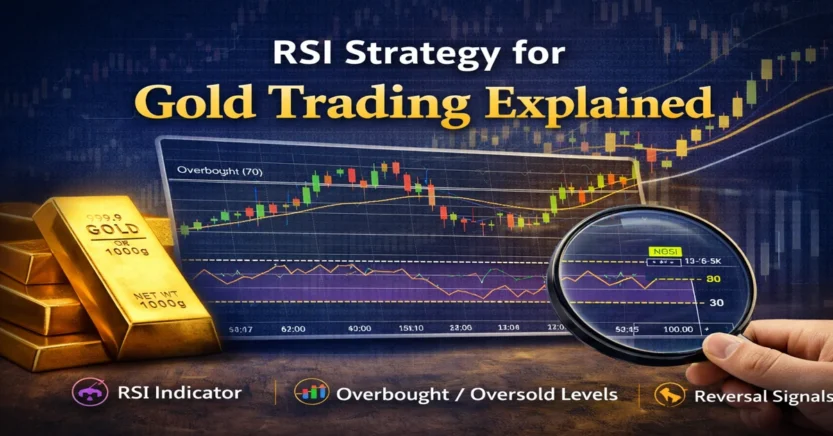
RSI Strategy for Gold Trading Explained: A Complete Guide for XAUUSD Traders
Gold trading is one of the most popular ways to profit in the forex market. However, without a clear strategy, traders often struggle to make consistent gains. For this reason, the RSI strategy for gold trading is one of the simplest and most effective methods to identify entry and exit points.
In this guide, you will learn how to use the Relative Strength Index (RSI) to trade gold successfully. In addition, you will understand how to avoid false signals and improve your overall trading performance.
Furthermore, to improve your trading skills, read our guide on Scalping Strategy for Gold Trading (XAUUSD) for faster entry techniques.
What Is RSI Strategy?
The RSI strategy for gold trading is based on the Relative Strength Index (RSI), a momentum indicator that measures the speed and strength of price movements.
In simple terms, RSI helps traders determine whether gold is overbought or oversold. As a result, it becomes easier to predict potential reversals in price.
The RSI indicator ranges from 0 to 100:
-
Above 70 → Overbought market
-
Below 30 → Oversold market
Therefore, traders use these levels to find possible buy and sell opportunities.
Why RSI Works Well in Gold Trading
Gold (XAUUSD) is known for its strong trends and sharp reversals. Because of this, RSI becomes a powerful tool for identifying turning points.
For example, when gold becomes overbought, the price often pulls back. On the other hand, when it is oversold, the price tends to rise.
As a result, RSI helps traders enter the market at better prices.
Best RSI Settings for Gold Trading
Choosing the right RSI settings is important for accuracy. Therefore, you should follow standard settings first.
Recommended settings:
-
RSI Period: 14
-
Overbought Level: 70
-
Oversold Level: 30
However, some traders adjust these levels to suit gold’s volatility. For instance,
-
75/25 for stronger trends
-
80/20 for extreme conditions
In general, the default settings work well for most traders.
How to Use RSI Strategy for Gold Trading
Now, let’s look at how to apply this strategy step by step.
1. Identify Overbought and Oversold Zones
The first step is to watch the RSI levels. Specifically,
-
RSI above 70 → Look for sell opportunities
-
RSI below 30 → Look for buy opportunities
However, do not enter immediately. Instead, wait for confirmation before placing a trade.
2. Wait for RSI Reversal Signal
A strong signal occurs when RSI moves back from extreme levels. In other words,
-
RSI drops below 70 → Sell signal
-
RSI rises above 30 → Buy signal
Therefore, this confirmation reduces false entries.
3. Combine RSI with Trend Direction
Trading with the trend improves accuracy. For example,
-
In an uptrend → Focus on buy signals
-
In a downtrend → Focus on sell signals
In addition, you can use moving averages to confirm the trend direction.
4. Entry Rules for RSI Strategy
Now, follow these setups:
Buy Setup:
-
RSI below 30
-
RSI crosses above 30
-
Market shows bullish movement
-
Enter buy
Sell Setup:
-
RSI above 70
-
RSI crosses below 70
-
Market shows bearish movement
-
Enter sell
As a result, you enter trades with higher probability.
5. Take Profit and Stop Loss
Risk management is essential in gold trading. For this reason, you must plan your exits.
For example:
-
Stop Loss: 15–30 pips
-
Take Profit: 20–50 pips
Therefore, always maintain a good risk-to-reward ratio.
RSI Divergence Strategy for Gold Trading
RSI divergence is an advanced technique that improves accuracy. In fact, it is widely used by experienced traders.
What is divergence?
Divergence happens when price and RSI move in opposite directions. As a result, it signals a possible trend reversal.
Types of RSI Divergence:
1. Bullish Divergence
-
Price makes lower lows
-
RSI makes higher lows
-
Indicates a potential upward reversal
2. Bearish Divergence
-
Price makes higher highs
-
RSI makes lower highs
-
Indicates a potential downward reversal
Therefore, divergence helps traders spot strong reversal signals early.
Best Timeframes for RSI Gold Trading
Choosing the right timeframe is very important. In general, higher timeframes are more reliable.
Recommended timeframes:
-
M5 (5-minute) → Scalping
-
M15 (15-minute) → Intraday trading
-
H1 (1-hour) → More stable signals
As a result, traders can choose based on their trading style.
Best Time to Trade Gold with RSI
Timing is crucial for success. Therefore, you should trade during active sessions.
Best trading sessions:
-
London Session
-
New York Session
During these sessions, gold shows strong movement and better opportunities. On the other hand, avoid trading during low liquidity periods.
Common Mistakes When Using RSI
Many traders misuse RSI. However, you can avoid these mistakes:
-
Entering trades too early
-
Ignoring the trend direction
-
Trading without confirmation
-
Overtrading based on every signal
-
Ignoring risk management
Therefore, discipline is key to consistent success.
Tips to Improve RSI Strategy for Gold Trading
To get better results, follow these simple tips. For example,
-
Combine RSI with support and resistance
-
Use RSI with moving averages
-
Wait for confirmation signals
-
Avoid trading during major news events
-
Practice on a demo account
In addition, always review your trades to improve your strategy.
Advantages and Disadvantages of RSI Strategy
Advantages:
-
Easy to understand
-
Works well in volatile markets
-
Helps identify reversals
-
Suitable for beginners
Disadvantages:
-
Can give false signals
-
Less effective in strong trends
-
Requires confirmation
Therefore, combining RSI with other tools improves accuracy.
RSI vs Other Indicators in Gold Trading
RSI is powerful, but it works best when combined with other indicators. For instance,
| Indicator | Purpose |
|---|---|
| RSI | Measures momentum |
| Moving Average | Identifies trend |
| MACD | Confirms trend strength |
In summary, combining indicators gives better results than using one alone.
Final Thoughts
The RSI strategy for gold trading is a reliable method for identifying entry and exit points in the XAUUSD market. By understanding overbought and oversold levels, using confirmation signals, and following the trend, traders can improve their performance.
In conclusion, consistency, patience, and discipline are essential for success. Therefore, when you apply this strategy correctly, you increase your chances of making profitable trades.
For real-time charts and technical indicators, you can use trusted platforms like TradingView to enhance your gold trading analysis.
