
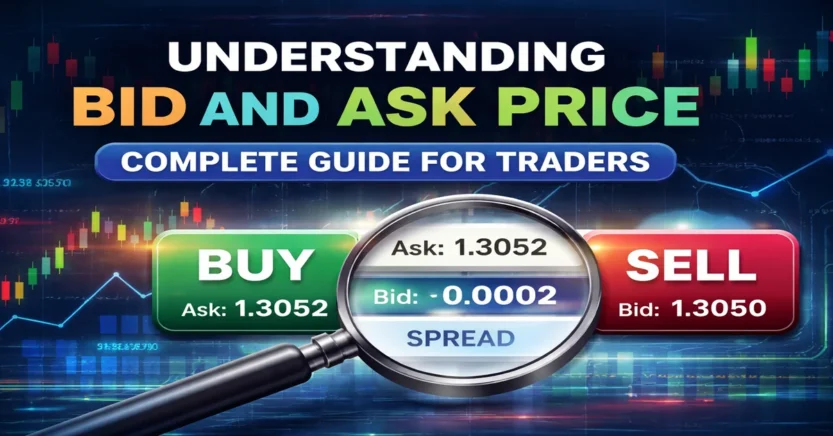
Understanding Bid and Ask Price: Complete Guide for Traders
Understanding bid and ask price is one of the most important concepts every trader must learn before entering the financial market. Whether you trade forex, synthetic indices, stocks, or commodities, bid and ask prices determine how you enter and exit trades. Without a proper understanding of this concept, many beginners struggle to make consistent profits.
In simple terms, the bid price represents the amount a buyer is willing to pay for an asset, while the ask price represents the amount a seller is willing to accept. The difference between these two prices is known as the spread, and it plays a crucial role in determining trading costs and profitability.
Many new traders focus only on indicators and strategies, yet they ignore how bid and ask prices work. As a result, they often enter trades at the wrong price and lose money without knowing why. Therefore, learning how bid and ask price works helps traders make smarter decisions, manage risks effectively, and improve their overall trading performance.
In this complete guide, you will learn everything about bid and ask price, including how it works, how to calculate it, why spreads change, and how it affects your trading results. By the end of this article, you will have a clear understanding of bid and ask price and how to use it to your advantage.
What Is Bid and Ask Price?
Bid and ask price refers to the two prices quoted for a financial asset in the market. These prices show the current buying and selling value of a currency pair, stock, or index.
The bid price is the highest price a buyer is willing to pay for an asset at a given time. On the other hand, the ask price is the lowest price a seller is willing to accept.
This system allows the market to function smoothly because buyers and sellers interact through price offers. When a buyer accepts the seller’s ask price, a trade is executed. Similarly, when a seller accepts the buyer’s bid price, the trade is completed.
For example, if EUR/USD shows:
Bid: 1.1000
Ask: 1.1002
This means traders can sell at 1.1000 and buy at 1.1002. The difference between these two prices is the spread.
Understanding this difference helps traders know the exact price they are entering the market.
Why Bid and Ask Price Exists
Bid and ask price exists because the market operates on supply and demand. Buyers want to buy at the lowest price, while sellers want to sell at the highest price. The market balances these interests through bid and ask pricing.
Market makers and liquidity providers also play a major role in setting bid and ask prices. They ensure there is always a buyer and seller available so trading can continue without delays.
Without bid and ask price, it would be difficult for traders to know the actual value of an asset. The system ensures fair pricing and smooth transaction flow in the financial market.
Additionally, the spread between bid and ask price allows brokers and liquidity providers to earn profit for facilitating trades.
Difference Between Bid Price and Ask Price
Understanding the difference between bid and ask price helps traders avoid confusion while trading.
Bid Price
The bid price is the price at which you can sell an asset. It represents the highest amount buyers are willing to pay in the market.
When you click the sell button on your trading platform, your trade is executed at the bid price.
This means if you want to sell EUR/USD, you will sell at the bid price shown on the chart.
Ask Price
The ask price is the price at which you can buy an asset. It represents the lowest amount sellers are willing to accept.
When you click the buy button, your trade is executed at the ask price.
This means if you want to buy EUR/USD, you will buy at the ask price.
Simple Explanation
Bid price is the selling price.
Ask price is the buying price.
This simple understanding helps traders avoid mistakes during entry and exit.
What Is Spread in Trading
The spread is the difference between bid and ask price. It represents the cost of trading and is usually measured in pips.
Spread = Ask Price − Bid Price
For example:
Bid: 1.2000
Ask: 1.2003
Spread = 3 pips
This means the trader pays 3 pips to enter the market.
Spreads vary depending on market conditions, liquidity, and trading sessions. During high volatility, spreads become wider, while during stable periods, spreads become smaller.
Understanding spreads helps traders choose the best time to enter the market and reduce trading costs.
Types of Spread
There are two main types of spreads in trading.
Fixed Spread
Fixed spread remains constant regardless of market conditions. Many brokers offer fixed spreads to provide stability and predictability for traders.
This type of spread is suitable for beginners because it makes trading costs easier to calculate.
However, fixed spreads may be slightly higher than variable spreads.
Variable Spread
Variable spread changes based on market conditions. During high liquidity, spreads become smaller, while during news events, spreads become wider.
Professional traders often prefer variable spreads because they can take advantage of tight spreads during active trading sessions.
Understanding the difference between fixed and variable spreads helps traders choose the right broker and trading strategy.
How Bid and Ask Price Works in Forex Trading
In forex trading, bid and ask prices appear on every currency pair.
For example:
EUR/USD
Bid: 1.1050
Ask: 1.1052
If you buy EUR/USD, you enter at 1.1052.
If you sell EUR/USD, you enter at 1.1050.
This means the trade starts with a small loss equal to the spread.
As the market moves in your direction, you begin to make profit.
This is why traders must understand bid and ask price before placing trades.
How Bid and Ask Price Works in Synthetic Indices
Bid and ask price also applies to synthetic indices such as Volatility 75.
When trading synthetic indices, the buy order is executed at the ask price, while the sell order is executed at the bid price.
This means the spread affects profit and loss just like in forex trading.
Traders who understand this concept can manage entries better and avoid unnecessary losses.
Importance of Understanding Bid and Ask Price
Understanding bid and ask price is important for several reasons.
First, it helps traders know the exact entry price in the market.
Second, it helps in calculating trading costs and spreads.
Third, it improves risk management and trade accuracy.
Fourth, it prevents confusion during buy and sell orders.
Finally, it helps traders develop better trading strategies.
When traders understand bid and ask price, they become more confident and make better trading decisions.
How Bid and Ask Price Affects Profit
Bid and ask price directly affects trading profit because every trade starts with a spread cost.
For example, if you open a trade with a 3-pip spread, the market must move 3 pips in your favor before you start making profit.
This means traders should avoid entering trades during high spreads.
Trading during low spreads increases profitability and reduces costs.
Therefore, understanding bid and ask price helps traders maximize profits and minimize losses.
How Market Makers Influence Bid and Ask Price
Market makers play a significant role in determining bid and ask prices in the financial market. They are institutions or brokers that provide liquidity by continuously quoting buy and sell prices for assets. Their main goal is to ensure that traders can enter and exit trades at any time without delays.
Market makers make money from the spread between bid and ask prices. When traders buy, market makers sell to them, and when traders sell, market makers buy from them. This continuous flow of buying and selling helps stabilize the market and maintain smooth price movement.
In forex trading and synthetic indices, brokers often act as market makers. They provide price quotes based on liquidity providers and market conditions. Therefore, the bid and ask price you see on your trading platform is influenced by these liquidity providers.
Understanding the role of market makers helps traders know why spreads sometimes increase and why prices move quickly during high volatility.
Role of Liquidity in Bid and Ask Price
Liquidity refers to how easily an asset can be bought or sold without affecting its price. High liquidity means there are many buyers and sellers in the market, while low liquidity means there are fewer participants.
Bid and ask prices depend heavily on liquidity. When liquidity is high, spreads become smaller because there are many buyers and sellers competing. On the other hand, when liquidity is low, spreads become wider because fewer traders are available.
For example, major currency pairs like EUR/USD usually have tight spreads because they have high liquidity. However, exotic pairs often have wider spreads due to low liquidity.
Synthetic indices also follow this concept, although they are generated by brokers. High market activity usually leads to tighter spreads.
Therefore, traders should always consider liquidity before entering trades.
Understanding Order Book and Price Levels
The order book is a list of buy and sell orders placed by traders at different price levels. It shows the demand and supply in the market.
The bid side of the order book shows buy orders, while the ask side shows sell orders. When buy orders increase, the bid price rises. When sell orders increase, the ask price moves downward.
This interaction between buyers and sellers determines the market price.
For example, if many traders want to buy an asset, demand increases, and the price moves upward. If many traders want to sell, supply increases, and the price moves downward.
Understanding the order book helps traders predict price movements and identify support and resistance levels.
Bid and Ask Price in Trading Platforms
Trading platforms display bid and ask prices in different ways. Some platforms show both prices clearly, while others show only one price on the chart.
Most platforms show the bid price on the chart, while the ask price appears slightly above it. The spread is the difference between these two prices.
In platforms like MT5 and Deriv, traders can enable the ask line to see both prices clearly. This helps in accurate entry and exit decisions.
When the ask line is visible, traders can easily see where their buy trades will be executed.
Understanding how platforms display bid and ask prices helps traders avoid confusion and place trades correctly.
How Bid and Ask Price Appears on Charts
On most trading charts, only the bid price is displayed by default. This means the chart reflects the selling price.
However, buy orders are executed at the ask price, which is slightly higher than the bid price.
This difference can sometimes confuse beginners because they see the chart touching a level but their trade does not activate. The reason is that the ask price has not reached that level yet.
Enabling the ask line on the chart solves this problem.
This small adjustment helps traders understand price movement more clearly and avoid mistakes.
Trading Sessions and Bid and Ask Price
Trading sessions also affect bid and ask prices. Different sessions have different levels of liquidity and volatility.
The major trading sessions include:
Asian session
London session
New York session
During the London and New York sessions, liquidity is usually high, and spreads are tight. This makes trading more cost-effective.
During the Asian session, liquidity is lower, and spreads may be wider.
News events and economic announcements can also cause spreads to widen suddenly.
Therefore, traders should pay attention to trading sessions when analyzing bid and ask prices.
Why Spreads Increase During News Events
Spreads often increase during major news events because of market uncertainty. When important economic news is released, price movement becomes unpredictable.
Liquidity providers widen spreads to protect themselves from sudden price changes. As a result, traders may experience higher trading costs during these periods.
For example, during interest rate announcements or major economic reports, spreads can widen significantly.
This is why many professional traders avoid trading during high-impact news events.
Understanding this behavior helps traders manage risk and avoid unnecessary losses.
If you want to learn more about spreads and how they affect trading costs, check our complete article on What Is Spread in Forex Trading and Why It Matters
Bid and Ask Price in Different Markets
Bid and ask price exists in all financial markets, including forex, stocks, commodities, and cryptocurrencies.
In the stock market, bid and ask prices represent buyers and sellers placing orders through exchanges.
Meanwhile, forex trading relies on liquidity providers to supply bid and ask price quotes to the market.
Additionally, cryptocurrency markets experience rapid bid and ask price changes because of high volatility.
Synthetic indices also use bid and ask pricing to simulate real market conditions.
This shows that bid and ask price is a universal concept in trading.
How Brokers Set Bid and Ask Prices
Brokers set bid and ask prices based on liquidity providers and market conditions. They receive price quotes from large financial institutions and pass them to traders.
Some brokers add a small markup to the spread as their profit. Others charge commission instead of spread markup.
There are two common broker models:
Market maker brokers
ECN brokers
Market maker brokers control price quotes and spreads, while ECN brokers provide direct market access.
Understanding broker models helps traders choose the best trading environment.
ECN vs Market Maker Bid and Ask Pricing
ECN brokers usually offer tighter spreads because they connect traders directly to liquidity providers. However, they charge commission per trade.
Market maker brokers offer fixed spreads but may have slightly wider spreads.
Each model has advantages and disadvantages.
ECN brokers are suitable for professional traders, while market maker brokers are suitable for beginners.
Understanding this difference helps traders select the right broker for their strategy.
Bid and Ask Price and Scalping Strategy
Scalping is a trading strategy that focuses on small price movements. Since scalpers target small profits, bid and ask price becomes very important.
Large spreads can reduce scalping profits significantly.
Scalpers usually trade during high liquidity periods to get tight spreads.
They also choose brokers with low spreads and fast execution.
Understanding bid and ask price helps scalpers improve efficiency and increase profits.
Bid and Ask Price and Swing Trading
Swing traders hold trades for longer periods, so spreads have less impact on their overall profit.
However, understanding bid and ask price still helps in choosing better entry points.
Swing traders focus more on trend analysis and market structure.
Even though spreads matter less, proper knowledge of bid and ask price improves trade accuracy.
Common Mistakes Traders Make with Bid and Ask Price
Many traders make mistakes because they do not fully understand bid and ask price.
One common mistake is entering trades without considering spread.
Another mistake is placing stop loss too close to the entry price.
Some traders also ignore trading sessions and liquidity.
These mistakes lead to unnecessary losses.
Avoiding these errors improves trading performance and profitability.
How to Calculate Bid and Ask Price in Trading
Calculating bid and ask price is an important skill for every trader because it helps determine trading costs, spreads, and potential profits. While trading platforms automatically display bid and ask prices, understanding how to calculate them manually improves trading accuracy and decision-making.
The basic formula for calculating spread is:
Spread = Ask Price − Bid Price
For example:
Bid: 1.3050
Ask: 1.3053
Spread = 1.3053 − 1.3050 = 0.0003
This equals 3 pips.
This means the market must move 3 pips in your favor before you start making profit. Therefore, traders must always consider the spread before opening a trade.
Understanding this simple calculation helps traders evaluate trading costs and manage risk effectively.
Understanding Pips in Bid and Ask Price
A pip is the smallest price movement in a currency pair or asset. It is used to measure changes in bid and ask prices.
In most forex pairs, one pip equals 0.0001. However, for pairs involving the Japanese yen, one pip equals 0.01.
For example:
EUR/USD moves from 1.1000 to 1.1001, which is 1 pip.
If the bid price is 1.1000 and the ask price is 1.1002, the spread is 2 pips.
Pips help traders calculate profit, loss, and spread costs accurately. Therefore, understanding pips is essential when learning bid and ask price.
Real Forex Example of Bid and Ask Price
Consider a real trading scenario.
EUR/USD shows:
Bid: 1.1200
Ask: 1.1202
You decide to buy.
Your trade opens at 1.1202.
If the price moves to:
Bid: 1.1205
Ask: 1.1207
You can sell at 1.1205.
Profit = 1.1205 − 1.1202 = 3 pips
This example shows how bid and ask price affects profit calculation.
Even though the price moved 5 pips on the chart, your actual profit is 3 pips because of the spread.
This is why understanding bid and ask price is important.
Understanding Bid and Ask Price in Volatility 75
In synthetic indices like Volatility 75, bid and ask price works the same way as forex.
The buy order is executed at the ask price, while the sell order is executed at the bid price.
For example:
Volatility 75
Bid: 3450.20
Ask: 3450.80
Spread = 0.60
If you buy, your trade starts at 3450.80.
If the price moves to:
Bid: 3451.20
Ask: 3451.80
You sell at 3451.20.
Profit = 3451.20 − 3450.80 = 0.40
This shows that spread affects profit even in synthetic indices.
Therefore, traders must monitor bid and ask price before entering trades.
How Bid and Ask Price Affects Stop Loss and Take Profit
Bid and ask price also affects stop loss and take profit levels.
For buy trades, stop loss and take profit are triggered using the bid price.
For sell trades, stop loss and take profit are triggered using the ask price.
This means traders must place stop loss carefully to avoid premature exit.
For example, if you place a tight stop loss on a buy trade, spread fluctuations may trigger it early.
Therefore, traders should always consider spread when setting stop loss and take profit.
This improves risk management and reduces unnecessary losses.
How to Reduce Spread Cost in Trading
Reducing spread cost is essential for improving profitability. There are several ways traders can achieve this.
First, trade during high liquidity sessions such as London and New York.
Second, avoid trading during major news events.
Third, choose brokers with low spreads.
Fourth, use limit orders instead of market orders when necessary.
Fifth, avoid trading during low market activity.
These simple strategies help reduce spread cost and increase profit potential.
Best Time to Trade Based on Bid and Ask Price
The best time to trade is when spreads are tight and liquidity is high.
London session provides high liquidity and stable spreads.
New York session also offers good trading opportunities.
The overlap between London and New York sessions usually has the lowest spreads.
During weekends or low activity periods, spreads may widen.
Therefore, traders should focus on active market hours.
This improves trade execution and reduces trading costs.
Advanced Strategies Using Bid and Ask Price
Professional traders use bid and ask price to develop advanced strategies.
One strategy involves analyzing spread changes to detect volatility.
Another strategy involves using order book analysis to predict price movement.
Traders also use bid and ask price to identify fake breakouts and liquidity zones.
When spreads widen suddenly, it may indicate market uncertainty.
Understanding these signals helps traders make better decisions.
Advanced knowledge of bid and ask price improves overall trading performance.
Risk Management and Bid and Ask Price
Risk management becomes more effective when traders understand bid and ask price.
Traders should always calculate spread before entering trades.
They should also adjust position size based on spread and market conditions.
Using proper stop loss placement helps protect capital.
Avoiding high spread periods reduces risk.
Good risk management combined with bid and ask knowledge leads to consistent trading results.
Proper risk control is important, so you should also read our article on forex risk management strategies for beginners to protect your trading capital.
Tips for Beginners to Understand Bid and Ask Price
Beginners should follow simple tips to understand bid and ask price easily.
Always check spread before trading.
Enable ask line on the trading chart.
Practice on demo account.
Trade during high liquidity sessions.
Avoid trading during news events.
Choose reliable brokers.
Focus on learning rather than rushing into profits.
These tips help beginners build confidence and improve trading skills.
Final Thoughts on Understanding Bid and Ask Price
Understanding bid and ask price is essential for every trader who wants to succeed in the financial market. It helps traders know the exact entry and exit price, calculate spread, manage risk, and improve profitability.
When traders understand how bid and ask price works, they avoid common mistakes and make better trading decisions. They also learn how to reduce trading costs and choose the best time to trade.
Bid and ask price is not just a basic concept. It is a powerful tool that helps traders understand market structure and price movement.
Many brokers and trading platforms provide bid and ask pricing, and you can explore platform features on the official MetaTrader website.
Therefore, every beginner and professional trader should master this concept before developing complex trading strategies.
With proper knowledge and practice, understanding bid and ask price becomes easy and useful in daily trading activities.
