
What Is Spread in Forex Trading and Why It Matters
If you are new to trading, you may be wondering what is spread in forex trading and why it appears on every currency pair. At first glance, trading platforms show two prices that look almost identical. However, there is always a small difference between them, and that difference is called the spread.
In simple terms, the spread is one of the most important concepts every trader must understand. Yet, many beginners ignore it. As a result, they often struggle with profitability without knowing the real cause.
In reality, the spread is a trading cost. Therefore, just like any other cost, it directly affects your profits. The more you understand it, the better your trading decisions will become.
In this guide, you will learn how spread works, why it matters, and how to reduce its impact on your trades.
To understand how smart money operates in the market, you should also read our guide on order blocks, which explains how institutional traders influence price movements.
What Is Spread in Forex Trading?
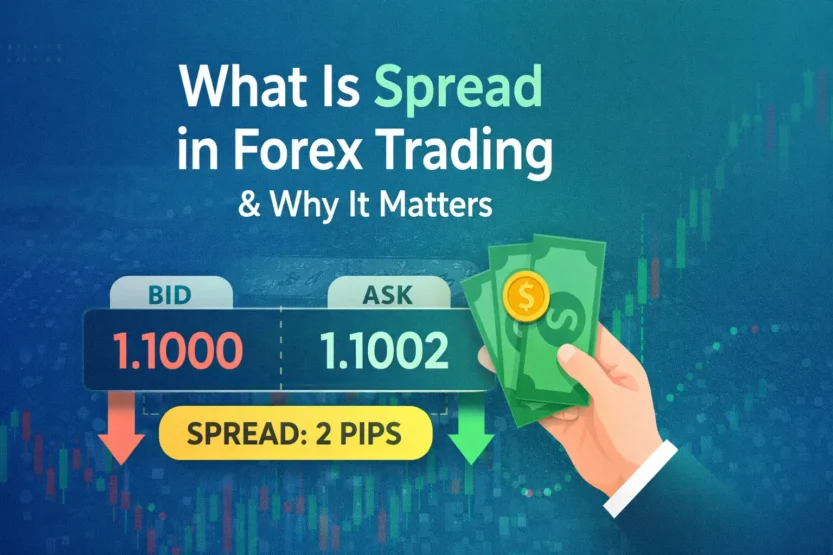
In forex trading, the spread is the difference between the bid price and the ask price of a currency pair.
- The bid price is the price at which you can sell
- The ask price is the price at which you can buy
Therefore, the spread can be calculated as:
Spread = Ask Price – Bid Price
For example:
- EUR/USD bid price: 1.1000
- EUR/USD ask price: 1.1002
In this case, the spread is 0.0002, which equals 2 pips.
As a result, every time you open a trade, you begin with a small loss equal to the spread. This is why understanding spread is crucial from the start.
Why Does Spread Exist?
First of all, spreads exist because brokers and liquidity providers need to earn from facilitating trades.
In the forex market:
- Brokers connect traders to liquidity
- Liquidity providers supply buy and sell orders
- Market makers ensure smooth execution
Therefore, instead of charging direct fees, many brokers include their earnings within the spread. In other words, traders pay indirectly.
Moreover, this system allows trading to remain simple, especially for beginners. However, it also means that every trade comes with a built-in cost.
Types of Spread in Forex Trading
Now that you understand the basics, let’s explore the different types of spreads.
1. Fixed Spread
A fixed spread remains constant regardless of market conditions.
For example, whether the market is calm or volatile, the spread does not change.
Advantages:
- First, it provides predictable costs
- In addition, it is easier for beginners
- Also, it protects against sudden spread spikes
Disadvantages:
- However, it is usually higher than variable spreads
- As a result, active traders may pay more
2. Variable (Floating) Spread
On the other hand, a variable spread changes depending on market conditions.
For instance, during high volatility, spreads widen. Meanwhile, during calm periods, they become tighter.
Advantages:
- Generally lower during normal conditions
- Therefore, ideal for scalping and day trading
Disadvantages:
- However, spreads can increase suddenly
- As a result, costs become unpredictable
3. Raw Spread (ECN Spread)
Finally, raw spreads are the tightest spreads available.
In most cases, they are close to zero. However, brokers charge a separate commission.
Advantages:
- Extremely low spreads
- Suitable for professional traders
Disadvantages:
- Commission fees apply
- Therefore, beginners may find it complex
How Spread Is Measured
In forex trading, spreads are measured in pips.
Typically:
- 1 pip = 0.0001 for most currency pairs
For example:
- GBP/USD moves from 1.2500 to 1.2501 = 1 pip
Additionally, some brokers use fractional pips, also known as pipettes.
Therefore, a spread may appear as 1.5 pips instead of 1 or 2 pips.
For a deeper understanding, you can refer to this explanation by Investopedia, which breaks down how spreads work in financial markets.
How Spread Affects Your Trades
Now, let’s examine why spread truly matters.
1. Immediate Loss on Entry
First, when you open a trade, you immediately start at a loss.
For example:
- Buy at 1.1002
- Sell price is 1.1000
Therefore, you are already down 2 pips.
2. Impact on Scalping
Next, spreads have a huge impact on scalping.
Since scalpers aim for small profits, even a small spread matters.
For instance:
- Target: 5 pips
- Spread: 2 pips
As a result, 40% of your profit is already gone.
3. Reduced Profit Margins
In addition, spreads reduce your overall profit.
Even if you are a swing trader, costs accumulate over time.
Therefore, frequent trading increases total expenses.
4. Break-even Distance
Furthermore, spreads increase the distance needed to reach profit.
For example:
- Spread = 3 pips
Therefore, price must move at least 3 pips before you break even.
Factors That Influence Spread
Several factors affect spreads. Understanding them helps you trade smarter.
1. Market Liquidity
First, high liquidity leads to tighter spreads.
For example, EUR/USD has low spreads because it is heavily traded.
2. Market Volatility
On the contrary, high volatility increases spreads.
For instance, during major news events, spreads widen significantly.
3. Trading Session
Additionally, spreads vary across sessions:
- London session: tight spreads
- New York session: moderate spreads
- Asian session: wider spreads
4. Currency Pair Type
Moreover, different pairs have different spreads:
- Major pairs: low spreads
- Minor pairs: moderate spreads
- Exotic pairs: high spreads
5. Broker Type
Finally, your broker plays a key role.
For example:
- Market makers: wider spreads
- ECN brokers: tighter spreads
Spread vs Commission: What’s the Difference?
At this point, it is important to compare spread and commission.
Spread-only model
- No commission
- However, spreads are higher
Commission-based model
- Lower spreads
- However, fixed fees apply
Therefore, you should always consider total trading cost.
How to Calculate Spread Cost
Let’s look at a practical example.
- Lot size: 1 standard lot
- Pip value: $10
- Spread: 2 pips
Therefore:
Cost = 2 × $10 = $20 per trade
As a result, you need to earn at least $20 just to break even.
Strategies to Reduce Spread Costs
Although spreads cannot be avoided, you can reduce their impact.
1. Trade During High Liquidity Hours
First, trade during London and New York sessions.
As a result, you get tighter spreads.
2. Choose the Right Broker
Next, select a broker with:
- Low spreads
- Fast execution
- Transparency
3. Avoid News Trading
Additionally, avoid trading during major news events.
This is because spreads widen significantly.
4. Trade Major Pairs
Moreover, focus on major currency pairs.
They offer better liquidity and lower spreads.
5. Use Limit Orders
Finally, consider using limit orders.
In some cases, they can reduce trading costs.
Common Mistakes Traders Make
Despite its importance, many traders make mistakes.
1. Ignoring Spread
First, some traders ignore spreads completely.
As a result, their strategy becomes less effective.
2. Chasing Low Spread Only
Next, traders choose brokers based only on spreads.
However, execution quality also matters.
3. Overtrading
In addition, frequent trading increases costs.
Therefore, quality trades are better than quantity.
4. Trading Exotic Pairs
Finally, trading exotic pairs often leads to high spreads.
Spread and Trading Styles
Different trading styles are affected differently.
Scalping
- Highly sensitive to spreads
- Requires ultra-low spreads
Day Trading
- Moderately affected
- Still benefits from tight spreads
Swing Trading
- Less affected
- Focuses on larger moves
Position Trading
- Least affected
- Spread becomes negligible over time
Real-Life Example
Let’s compare two traders.
Trader A:
- Spread: 1 pip
- 10 trades daily
Trader B:
- Spread: 3 pips
- 10 trades daily
Therefore, Trader B pays three times more in costs.
Over time, this difference becomes significant.
Why Spread Matters More Than You Think
At first, the spread may seem small. However, it adds up quickly.
Over time:
- It reduces profits
- It increases losses
- It affects consistency
Therefore, understanding spread is essential for success.
Final Thoughts
In conclusion, spread is a fundamental part of forex trading. Although it may seem minor, it has a major impact on your performance.
By understanding what spread in forex trading is, you gain an advantage. Moreover, by applying the right strategies, you can reduce costs and improve profitability.
Ultimately, successful traders pay attention to every detail. And without a doubt, mastering spread is one of those details that can set you apart.
