
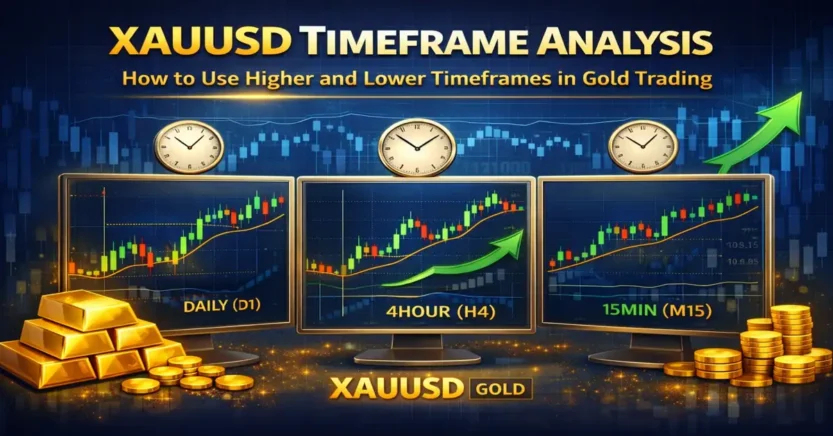
XAUUSD Timeframe Analysis: How to Use Higher and Lower Timeframes in Gold Trading
Gold trading continues to attract many traders because of its strong price movements and daily opportunities. However, many traders struggle with entries and exits due to poor XAUUSD timeframe analysis and lack of multi timeframe understanding. As a result, trades often fail even when the trend looks clear on a single chart. Proper analysis of higher and lower timeframes helps traders understand market direction and improve entry accuracy.
XAUUSD timeframe analysis helps traders understand the market from a broader perspective. Instead of relying on a single chart, traders study both higher and lower timeframes to identify trend direction and precise entry points. In this way, trading decisions become more structured and reliable. Moreover, combining different timeframes improves risk management and increases overall consistency.
Higher timeframes provide the main market direction, while lower timeframes offer detailed entry opportunities. Consequently, traders can follow the trend and avoid unnecessary losses. In addition, this method reduces emotional trading because decisions are based on clear market structure rather than guesswork.
This guide explains how to use higher and lower timeframes in XAUUSD analysis, how multi timeframe trading works, and how traders can apply it effectively in real market conditions.
What is XAUUSD Timeframe Analysis
XAUUSD timeframe analysis refers to studying gold price movement across multiple timeframes to understand trend direction and entry opportunities. Instead of depending on one chart, traders analyze several timeframes to get a complete market picture. Therefore, trading decisions become more accurate and structured.
Higher timeframes such as Daily and H4 reveal long-term trends and key support and resistance levels. On the other hand, lower timeframes like H1 and M15 help traders identify precise entry and exit points. As a result, combining both timeframes creates a balanced and effective trading approach.
Professional traders prefer this method because it reduces market confusion. While a single timeframe may show mixed signals, multiple timeframes provide clearer confirmation. Consequently, traders can make confident decisions based on strong market alignment.
In addition, timeframe analysis improves discipline. Traders learn to wait for proper setups instead of entering trades randomly. Over time, this approach leads to better performance and consistent results.
Understanding Higher Timeframes in Gold Trading
Higher timeframes play a major role in gold trading because they reveal the true market direction. Charts such as Weekly, Daily, and H4 provide a wider view of price movement and trend strength. Therefore, traders can easily identify the overall market structure.
One important benefit of higher timeframes is trend clarity. Since larger charts show long-term movement, traders can follow the main trend without distraction. As a result, trading against the market becomes less likely.
Another advantage is strong support and resistance identification. Higher timeframes highlight key price levels where gold often reacts. Consequently, traders can place stop loss and take profit more effectively.
Market noise also reduces on higher timeframes. Small price fluctuations that appear on lower charts become less significant on larger charts. In this way, traders focus on major movements instead of minor fluctuations.
Furthermore, higher timeframe analysis improves patience. Traders learn to wait for proper pullbacks before entering the market. This disciplined approach increases the probability of successful trades.
Role of Lower Timeframes in Market Entry
Lower timeframes provide detailed market information and precise entry opportunities. Charts such as H1, M30, and M15 show short-term price movements that help traders refine their entries. Therefore, trade timing becomes more accurate.
Lower timeframes are useful for identifying breakouts and trend continuation signals. For example, traders can spot candlestick patterns and momentum shifts more clearly. As a result, entries become more controlled and calculated.
In addition, smaller timeframes allow traders to reduce stop loss size. A tighter stop loss improves risk-to-reward ratio and increases potential profit. Consequently, traders can manage risk more effectively.
However, lower timeframes also contain market noise. False signals often appear due to rapid price movements. For this reason, traders should always confirm lower timeframe signals with higher timeframe analysis.
When both timeframes align, trading becomes more reliable and structured.
Understanding candlestick behavior on lower timeframes becomes easier when traders study price action in detail, which is explained in our Candlestick Patterns XAUUSD Beginner’s Complete Guide.
Why Multi Timeframe Trading Improves Accuracy
Multi timeframe analysis is essential because it combines trend direction with precise entry timing. Instead of guessing market movement, traders follow a structured approach that improves accuracy.
First, this method increases trade success rate. When higher and lower timeframes agree, the probability of a profitable trade becomes higher. As a result, traders experience fewer losing trades.
Second, false signals reduce significantly. Lower timeframe breakouts often fail, but higher timeframe confirmation filters weak setups. Therefore, traders avoid unnecessary risks.
Third, risk management improves because stop loss and take profit are based on strong market levels. Consequently, trading becomes safer and more consistent.
Finally, confidence increases because decisions are based on clear analysis. Traders feel more comfortable holding positions when multiple timeframes support the trade.
Step-by-Step Guide to Analyzing Gold Charts
Step 1: Analyze the Daily Timeframe
The first step is studying the Daily chart to understand the main market trend. Traders should identify support and resistance levels, trend direction, and market structure.
This step provides the foundation for the entire analysis. Therefore, skipping it can lead to poor trading decisions.
Step 2: Confirm Trend on H4
After analyzing the Daily chart, traders should move to the H4 timeframe for confirmation. This chart shows whether the trend is continuing or slowing down.
In addition, H4 reveals pullbacks and momentum changes. As a result, traders gain better understanding of market direction.
Step 3: Plan Entry on H1
The H1 timeframe helps traders plan entry zones and identify potential setups. At this stage, traders should focus on price action and breakout signals.
Consequently, trade preparation becomes clearer and more structured.
Step 4: Execute Entry on M15
The final step involves using M15 for precise entry. Traders can identify candlestick patterns and momentum signals to enter the market.
As a result, stop loss becomes smaller and risk reduces significantly.
Best Timeframe Combinations for XAUUSD
Different trading styles require different timeframe combinations. Therefore, traders should choose based on their strategy.
Swing traders usually combine Daily, H4, and H1 to capture medium-term movements. Meanwhile, intraday traders prefer H4, H1, and M15 for faster trades.
Scalpers often use H1, M15, and M5 for quick market entries. In each case, higher timeframe provides direction while lower timeframe offers entry precision.
Choosing the right combination improves trading efficiency and reduces confusion.
Practical Example of XAUUSD Timeframe Analysis
Consider a situation where the Daily chart shows an uptrend. H4 then shows a pullback to support, while H1 indicates bullish momentum. Finally, M15 confirms a breakout pattern.
In this scenario, traders can enter a buy position confidently. Stop loss can be placed below support, while take profit targets the next resistance.
As a result, risk remains controlled and profit potential increases. This example shows how timeframe alignment improves trading decisions.
Common Mistakes in Timeframe Analysis
Many traders make avoidable mistakes when using timeframe analysis. One common error is ignoring the higher timeframe trend. As a result, trades move against the market and fail quickly.
Another mistake is using too many timeframes. Instead of clarity, traders experience confusion and hesitation. Therefore, limiting analysis to three or four timeframes is better.
Entering trades without confirmation is also risky. Lower timeframe signals should always match higher timeframe direction. Otherwise, losses become frequent.
Overtrading based on small price movements can also damage performance. Patience and discipline remain essential for success.
When to Use Higher and Lower Timeframes
Higher and lower timeframes should be used in trending markets for best results. Clear trends provide stronger signals and better entry opportunities.
High volatility sessions also support timeframe analysis because price moves actively. Meanwhile, news periods require careful confirmation before entering trades.
Ranging markets demand extra caution because signals become weaker. Therefore, traders should wait for clear breakout confirmation.
Understanding market conditions improves decision-making and reduces risk.
Risk Management in XAUUSD Timeframe Analysis
Risk management remains a key part of gold trading. Traders should risk only a small percentage of capital on each trade. In addition, stop loss must always be placed at logical market levels.
Take profit should follow resistance or support zones to maintain balance. Proper lot sizing also reduces emotional pressure during trading.
Consequently, traders can maintain steady account growth and long-term stability.
Advantages of XAUUSD Timeframe Analysis
This strategy offers several important benefits. Clear trend direction improves decision-making and reduces confusion. Accurate entries increase profitability and lower risk.
Better risk management protects trading capital and improves consistency. Reduced false signals help traders maintain discipline and confidence.
As a result, XAUUSD timeframe analysis becomes a powerful tool for both beginners and professional traders.
Final Thoughts
XAUUSD timeframe analysis provides a structured and reliable way to trade gold. By combining higher and lower timeframes, traders can understand market direction and enter trades with precision. Consequently, trading becomes more consistent and less risky.
Higher timeframes guide the overall trend, while lower timeframes refine entry points. When both align, traders gain a strong advantage in the market. In addition, proper risk management ensures long-term success.
Consistency, patience, and discipline remain essential in gold trading. Traders who apply multi timeframe analysis regularly often achieve better results over time. With continuous practice and proper planning, this strategy can significantly improve trading performance and confidence.
Real-time gold market updates from Investing help traders confirm trends across multiple timeframes.
